


Personal injury practices face a common bottleneck even when liability evidence is available, treatment records have arrived, and the client is ready for the next step. The demand package remains unfinished because medical records, bills, wage documents, and incident evidence must be reconciled before counsel can evaluate settlement strategy.
Demand letter drafting services help firms move this work forward without transferring legal judgment away from the attorney. A trained paralegal team can organize records, build a medical chronology, prepare a damages summary, and assemble a structured draft for attorney review. The value comes from disciplined preparation, not from automated settlement decisions.
This guide explains what a quality demand package includes and how AI-enabled virtual paralegals cut preparation time to 24 hours. It also covers the professional-responsibility rules that govern the arrangement and the state requirements that can shape a demand.
Why a Demand Letter Backlog Costs More Than Time
Delay in a personal injury file carries three costs: treatment records age, client expectations drift, and limitation periods keep running. Those periods also vary by the state, so a stalled demand can leave less margin than the file appears to have. As a result, senior staff lose hours better spent on claim evaluation when they assemble exhibits.
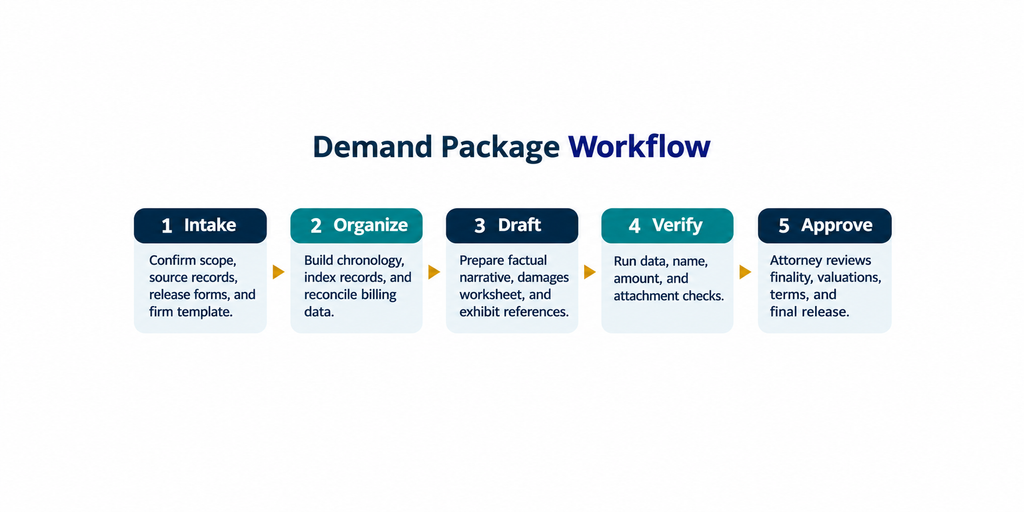
Where Demand Files Typically Stall
Most stalled files share a few recurring gaps, and mapping them shows where delegation helps and where attorney judgment must stay. The table below pairs each gap with a practical fix that firms can apply before outsourcing any work.
| Workflow Gap | What It Looks Like | Practical Fix |
| Scattered records | Provider files arrive in mixed formats and order | Index by provider and date; make files searchable |
| Bill mismatches | Charges do not align with treatment dates | Reconcile each bill against the treatment record |
| Slow chronology | Summaries wait for free staff time | Draft the chronology while intake review continues |
| Template drift | Every letter looks different | Load the firm template before drafting begins |
| Exhibit labeling | Final hours go to citations | Label exhibits as records are processed |
What Demand Letter Drafting Services Include
A defensible demand package presents liability, injuries, treatment, expenses, and damages in an order an adjuster can follow. At-fault and uninsured demand letters are prepared for motor vehicle, premises liability, dog bite, and DUI matters. Each draft follows the firm’s template and goes to the supervising attorney for review before dispatch.
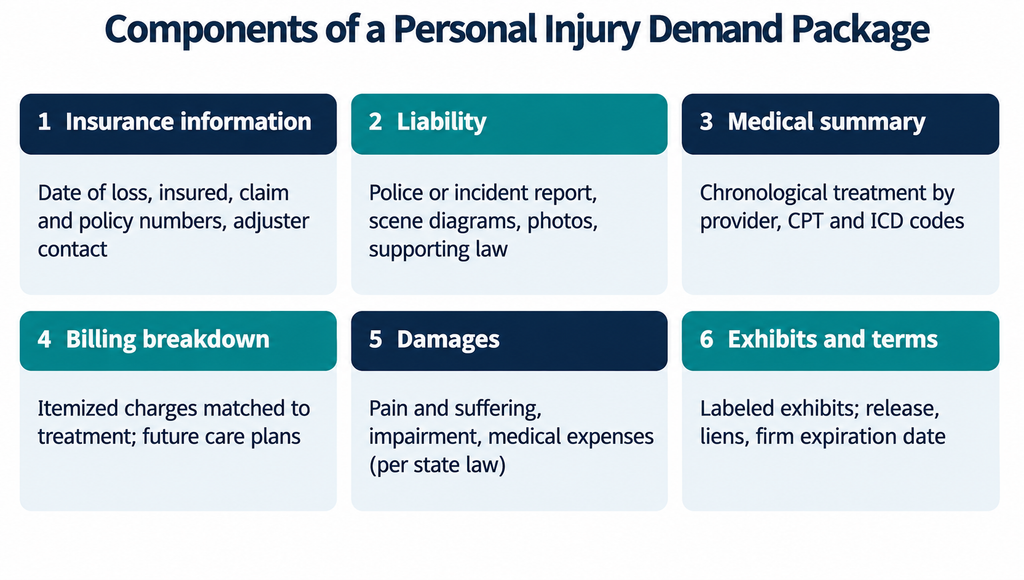
The Six Components of a Demand Package
The package should read as a single argument that labeled evidence supports at every step. The drafts include insurance details, a liability description, a medical summary with billing breakdown, a damages calculation, exhibits, and settlement terms.
The graphic below shows how those parts fit together in order:
What Your Team Needs to Send
Turnaround depends on how complete the intake package is when it reaches the paralegal team. For the 24-hour standard, a team needs to share the insurance information, the incident or police report, and the client’s medical records and bills. Optional supporting documents improve first-pass quality, and the list below shows what firms commonly add to the file.
The documents that need to be shared include:
- EOBs and billing ledgers
- Lien or letter-of-protection documentation
- Wage-loss records
- Vehicle damage photographs and scene diagrams
- Witness statements and body camera recordings
Liability and Damages: Where Demand Letters Are Won or Lost
Liability sections persuade when they tie each negligent act to a specific source document in the file. Liability descriptions are drafted from the police or incident report, scene diagrams, photographs, and the client intake sheet. Supporting statutes and case law appear in your firm’s format, with the attorney confirming current validity.
Damages sections work best when each claimed category rests on documented figures and a stated method. Then, the past and future pain and suffering, impairment, disfigurement, medical expenses, and loss of enjoyment of life are quantified. Which categories apply depends on state law, so the attorney decides how each is argued.
How AI-Enabled Virtual Paralegals Deliver in 24 Hours
Speed comes from separating mechanical record work from the judgment work that belongs to your team. AI-enabled workflows handle the mechanical layer, such as text recognition, record sorting, duplicate removal, and first-pass chronology drafts. Trained paralegals then verify every extracted fact against the source record before anything reaches the attorney.
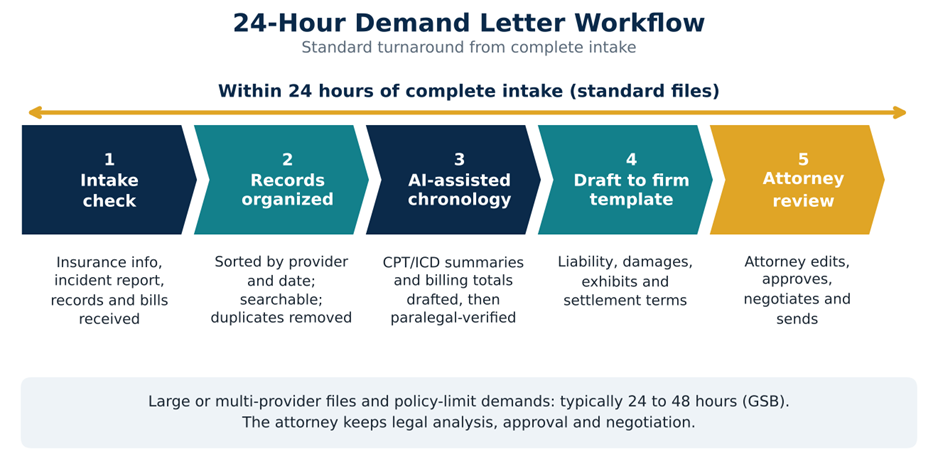
What Are the Five Stages of a 24-Hour Cycle?
Each stage in the graphic above maps to a service element. Records are organized by provider and date, summarized with CPT and ICD codes, and matched to an itemized billing breakdown. A paralegal drafts to your template, and the supervising attorney reviews and approves the letter before dispatch.
Turnaround Conditions
The 24-hour standard assumes complete intake and a manageable volume of records for the assigned paralegal. The typical turnaround for time-sensitive policy-limit demands is 24 to 48 hours, depending on volume, provider count, and intake. Files with surgical records, injections, or many treating providers deserve an early scope conversation with the team.
Quality Controls Before Dispatch
A reliable 24-hour process includes quality checks that never depend on how quickly the draft was assembled. Reviewers should reconcile billed totals against itemized charges, confirm that each date matches the treatment record, and verify every exhibit reference. Expert teams maintain an accuracy rate above 99 percent, which firms can test independently during the pilot project.
What AI Should and Should Not Do in Demand Preparation
AI earns its place on repetitive record tasks, and it has no role in reaching legal conclusions. Use it for extraction and organization, and keep human review on anything that reaches an adjuster. The two lists below separate suitable automation from work that requires a trained person’s judgment.
| Suitable For AI-Assisted Handling | Requires Human Judgment |
| Text recognition and searchable files | Verifying each fact against the source record |
| Sorting records by provider and date | Characterizing liability and causation |
| Duplicate removal and bookmarking | Choosing the demand amount and settlement terms |
| First-pass chronology and bill totals | Approving the final letter and negotiating |
What Standards Should Be Set Before You Delegate Demand Work
ABA Formal Opinion 08-451 allows lawyers to outsource support work if they stay responsible for competent representation. Lawyers must also supervise outside providers under Model Rules 5.1 and 5.3, as the opinion explains. Comment [3] to Rule 5.3 asks for reasonable efforts to keep outside services compatible with those obligations.
Maintaining confidentiality is critical, and ABA Formal Opinion 08-451 advises informed client consent before confidential information reaches an outsourcing provider. ABA Formal Opinion 512 (2024) adds that lawyers must understand an AI tool’s risks and verify its output. All workflows followed must be HIPAA-aware workflows, with controlled file access, confidentiality agreements, and secure file transfer for case materials.
All preparation must occur under attorney supervision, with legal analysis and negotiation remaining with the attorney. That division follows the supervision model above and respects the unauthorized-practice limits in Rule 5.5. Document the scope in a written agreement so every task has a defined owner and review step.
State Demand Rules Can Change the Letter
Some states regulate pre-suit time-limited demands by statute, so a generic template can create risk. Drafting instructions to your paralegal team should name the governing statute for each file you assign. The two examples in the table below show how much required content can differ between jurisdictions.
| State | Authority | Notable requirements |
| California | Code Civ. Proc. § 999.1 | Written, labeled demand; at least 30 days to accept (33 if mailed); offer to settle all claims within limits, including liens; complete release of insureds; reasonable proof |
| Georgia | O.C.G.A. § 9-11-67.1 (revised 2024) | Governs pre-answer motor vehicle settlement offers; lists the material terms; acceptance period of at least 30 days from receipt |
Cost, Capacity, and Billing Models
Backlog relief should not require a permanent hire, particularly when case volume rises and falls through the year. Teams charge hourly billing, case-based pricing, and monthly engagement models, and a hire-when-you-need option for firms with fluctuating volume. Firms can scale support up during settlement pushes and pause it when the pipeline thins.
Cost comparisons should include recruiting, training, benefits, workspace, and supervision time, not just a new hire’s wage. For context, the Bureau of Labor Statistics reports a median paralegal wage of $62,890 in May 2025, before those added costs. Measure the full cost of each finished demand, including attorney review time, to compare options fairly.
How to Evaluate a Demand Letter Paralegal Service
Choose a provider based on process and evidence, not promises, and test the claim with one live file before committing. Opt for a free pilot project, which lets your attorneys judge accuracy, formatting, and turnaround against your own template. Use the checklist below to score each provider you consider against the same firm criteria.
- Does the provider follow your template and cite sources to labeled exhibits?
- Are HIPAA-aware safeguards and confidentiality agreements documented in writing?
- Is turnaround defined, with stated conditions for larger files?
- Does an attorney review every letter before it leaves the firm?
- Can the provider work inside your case management software?
Wrapping Up: Clear the Backlog Without Losing Control
A demand backlog is a capacity problem, and a disciplined process can solve it without permanent hiring. Structured intake, AI-assisted record handling, and paralegal verification can produce a review-ready draft within a day on standard files. Attorneys keep every decision that matters, and the file moves toward settlement instead of sitting in a queue.
Ready to test the process? Get in touch with GSB LPO Services and share your requirements.
Frequently Asked Questions
How should a demand letter handle pre-existing conditions?
Address pre-existing conditions directly, because the records will reveal prior treatment and adjusters will find it. The demand should explain what changed after the incident and cite the treating providers’ findings that support the difference. Model Rule 4.1 also bars lawyers from making false statements of material fact to third parties during negotiation.
What should we do when an adjuster asks for more records after the demand is sent?
Respond in writing and supply only records that are relevant to the claim and covered by the client’s authorization. A records request does not extend a time-limited demand unless the demand’s terms or a written agreement provide for it. Log every exchange so the supervising attorney can show diligence if the claim later escalates.
When is the right time to send a personal injury demand letter?
Timing is an attorney decision tied to the client’s treatment status and the limitation deadline. Many firms wait for maximum medical improvement or a stable treatment plateau so future care and damages can be quantified. Waiting has limits, however, because the statute of limitations keeps running regardless of treatment status.
What happens if the insurer rejects the demand or lets the deadline pass?
Use up and down arrow keys to resize the meta box pane.
The attorney decides the next step, such as a supplemental demand, more negotiation, or suit before limitations expire. Preserve the demand, proof of delivery, and the insurer’s response, since they may matter if the insurer’s handling is later disputed. Standards for insurer conduct differ by state, so confirm local law before relying on any deadline.