

SDT Records Management Paralegal Services for U.S. Workers' Compensation Law Firms
Subpoena Duces Tecum ordering, tracking, and records management for applicant and defense-side workers' compensation practices.
 Medical, Employment, Insurance & Billing Records
- SDT Request Preparation and Placement
- Records Tracking, Follow-ups & Downloading
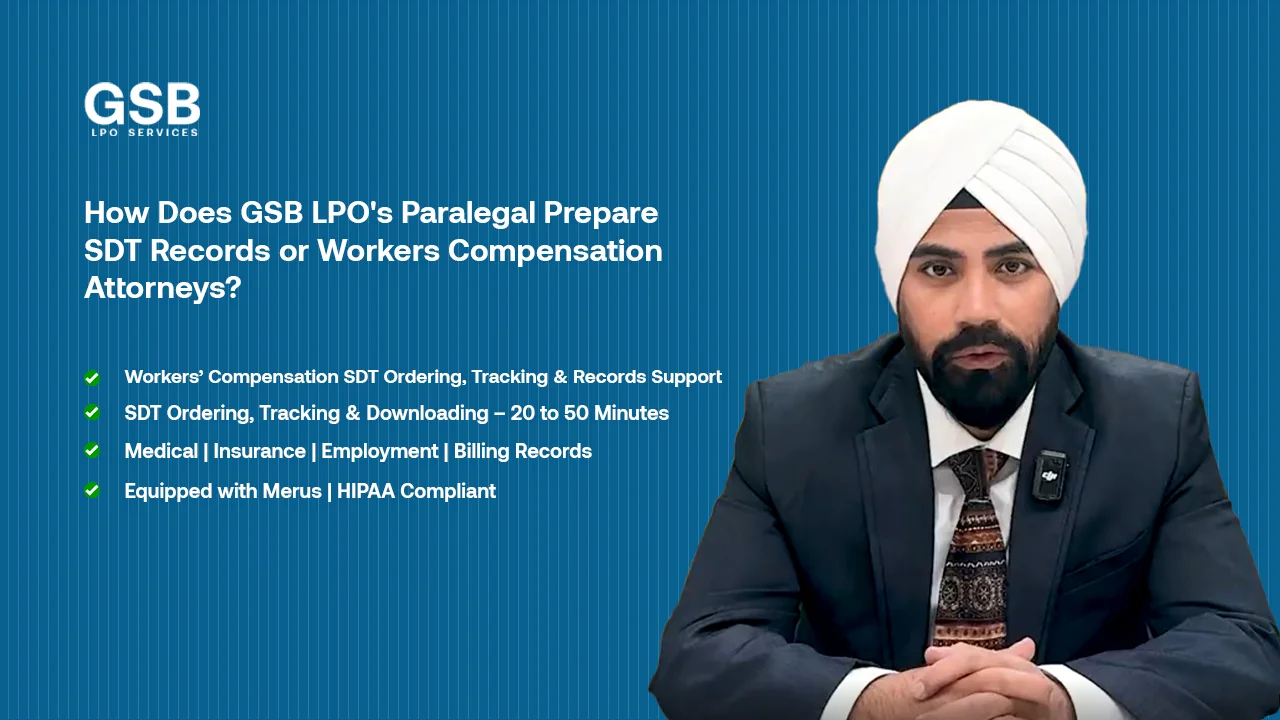
- 20-50-Minute SDT Ordering and Tracking Support
- Merus-Compatible Records Organization
Try Our Free Pilot Project
Delivery within 24 Hours.
SDT Legal Support for Workers' Compensation Attorneys
GSB LPO Services offers legal assistance related to SDT specifically for workers' compensation lawyers in the United States who handle cases on behalf of applicants or defense. The process includes administrative assistance in coordinating SDTs, including the issuance of the order and collecting all relevant documents.
We collaborate with copy and record custodians, keep track of pending orders, and organize all received medical, employment, insurance, and billing documents according to lawyers’ requirements. We make sure that all decisions related to discovery and relevancy of the documents are made by the lawyer.
Our Monthly Drafting & Filing Capacity
Proven Capacity
Rapid Filing
Years Of Experience
%
Error Free Writing
Our Subpoena Duces Tecum Records Services Include

SDT Ordering & Placement
Ordering and filing subpoena duces tecum requests for medical, employment, insurance, and billing records using authorized copy services as per instructions from U.S. attorneys.

Medical Records SDT Requests
Arranging requests to hospitals, clinics, physicians, physiotherapy providers, diagnostic centers, and other health care providers.

Employment & Wage Records SDT Requests
Arranging requests for employment records, wage details, personnel files, and other work-related records that can be used in workers’ compensation claims.

Insurance & Billing Records SDT Requests
Arranging requests for insurance information, billing information, and other records that may be useful in claim assessment and settlements.

SDT Tracking & Follow-Ups
Monitoring request status and keeping records of outstanding requests and following up with copy service providers and records custodians for delayed productions.

Records Receipt & Organization
How Does the SDT Records Management Process Work?
The GSB LPO Services implements an established SDT process to assist U.S. law firms in managing subpoena requests and any outstanding records without involving any routine administration on the firm side.
Share SDT Instructions
The firm provides the subpoena information, the record categories, the custodian data, the date ranges, and the instructions for the copy service.
Prepare and Place Requests
GSB LPO Services prepares the SDT requests that have been allocated and arranges their placement via the approved copy service.
Track Outstanding Records
All requests are followed up on for their status and pending production as and when needed.
Receive and Download Records
The available records are collected or downloaded using the appropriate copy-service or custodian method.
Organize Records for Review
The records are organized based on the provider, custodian, date range, and type of documents.
Deliver and Update Status
GSB LPO Services sends the organized records to the firm and reports the status of the completed requests, outstanding production, and problems.
How Does SDT Records Management Benefit Workers' Compensation Attorneys?

Improves Discovery Efficiency

Reduces Administrative Workload

Minimizes Records Delays

Supports Hearing and Settlement Preparation

Improves Records Organization
Preserves Attorney Control
What Information Should the Law Firm Provide?
The following information will be needed for any SDT project that the GSB LPO Services performs:
Case Details
Case number, claimant information, employer information, and all other information that pertains to the case.
Custodian Information
Names and addresses of healthcare providers, employers, insurance companies, or any other custodian of records.
Record Specifications
Categories of records to request, date ranges, and documents to be requested.
Subpoena Instructions
Attorney-approved SDT forms, copy-service preferences, and applicable procedural instructions.
Tracking Requirements
Frequency of updates, priority information, deadlines, and preferred form of reporting.
File Management Preferences
Naming convention, file structure, and compatible case management systems.
Reference Letters from Leading US Law Firms and Attorneys
Want to see how our virtual paralegal team can support your law firm?
Start with a free plict project and review our work quality before committing to ongoing support
How Does GSB LPO Services Ensure Confidentiality in SDT Records Management?
Subpoenaed records often contain sensitive medical, employment, insurance, and financial information. GSB LPO Services follows defined confidentiality and document-handling procedures to support responsible management throughout the SDT workflow.

Restricted Access Controls
SDT-related documents are only available to the people designated for the matter, according to the existing access protocol.

Secure Handling of Subpoenaed Records
Medical, employment, and billing documents are handled using the agreed procedure to maintain confidentiality.

Attorney-Centric Support Model
GSB LPO Services handles SDT ordering, tracking, and records organization. The discovery process is the responsibility of the U.S. attorney.
Secure File Transfer and Platform Access
Records are shared through the agreed channel and managed on the designated platform, such as Merus.

Confidentiality Throughout the Workflow
Document handling procedures are followed at all steps of the process, from request preparation, order tracking, records retrieval, organization, and delivery.
Benefits of Partnering with GSB LPO Services
GSB LPO Services offers specialized workers' compensation paralegal services in the United States by coordinating SDT along with a flexible and attorney-led workflow.
Confidentiality
Controlling document access and following confidentiality and file-sharing agreements helps keep the information safe.
24-Hour Turnaround
Normal tasks are usually completed in 24 hours, depending on document availability and the scope of assignments.
99% Accuracy Rate
Quality control processes facilitate accurate SDT documentation, record-keeping, and administration.
Reduce Costs by 30-50%
Outsourcing saves the cost of recruiting, training, and hiring additional workers.
Workers' Compensation Experience
Specialized support in SDT ordering, medical records, employment records, insurance documentation, and billing records.
Seamless Software Integration
Workflow is integrated with the templates of the firm, document software, and Merus case management system.
How do we charge for Virtual Paralegal Services?
Choose from flexible hourly, case-based, and monthly pricing tailored to your firm's workload and requirements. Our virtual paralegal services are scalable, cost-effective, and customized for U.S. law firms of every size. Explore our pricing options and start with a free pilot project to evaluate our services.
$12 /hr
Made for a steady case flow. It lowers daily workload and keeps your work consistent.
Most Popular
$15 /hr
This plan works with small and occasional tasks. It helps you stay on track without raising overhead costs.
$20 /hr
Ideal for firms that need high priority turnaround. This plan saves your team’s overtime.
Try our free pilot project to evaluate our operations.
Frequently Asked Questions
1. What is SDT records management in workers’ compensation cases?
SDT records management involves coordinating the ordering, tracking, receipt, and organization of records obtained through a Subpoena Duces Tecum. These may include medical, employment, wage, insurance, and billing records.
2. What types of records can be requested through a workers' compensation subpoena?
Depending on the case and U.S. attorney instructions, SDT requests may cover medical treatment records, diagnostic reports, employment files, wage statements, insurance documentation, and billing records.
3. How quickly does GSB LPO Services place workers' compensation SDT requests?
GSB's live service page describes typical SDT ordering and tracking tasks as taking approximately 20-50 minutes, subject to U.S. attorney instructions and records availability.
4. Does GSB LPO Services coordinate directly with copy services and records custodians?
Yes. GSB LPO Services coordinates SDT orders through approved copy services and conducts administrative follow-ups to monitor request status and outstanding records.
5. How does GSB LPO Services track outstanding SDT requests?
Each request is monitored through a tracking workflow that records its status and pending production. Follow-ups help identify delays and keep the law firm informed of outstanding records.
6. Does GSB LPO Services review or summarize subpoenaed medical records?
No. GSB's SDT service focuses on ordering, tracking, receiving, and organizing records. Substantive medical review, interpretation, summarization, and discovery strategy remain with the U.S. attorney or designated legal professionals.
7. How are subpoenaed records organized after receipt?
Records are organized by provider, custodian, date range, and document type. This creates a structured file that is easier for U.S. attorneys and legal teams to access and review.
8. How does GSB LPO Services protect sensitive information in SDT records?
GSB LPO Services follows confidentiality procedures, controlled-access practices, and agreed document-transfer workflows. These processes support the responsible handling of sensitive medical, employment, and financial records.
9. Can GSB LPO Services manage high volumes of workers' compensation SDT records?
Yes. GSB's records-management workflow is designed to support multiple requests, large medical record productions, and records from different providers and custodians.
10. Does GSB LPO Services determine which records should be requested through an SDT?
No. The U.S. attorney determines the appropriate custodians, record categories, scope, relevance, and legal basis for each subpoena. GSB LPO Services handles the assigned administrative coordination and records-management tasks.
11. Why do workers' compensation law firms outsource SDT records management to GSB?
Law firms outsource SDT records management to reduce administrative workload, improve discovery efficiency, and ensure organized record handling without increasing internal staffing. Outsourcing allows attorneys to focus on legal analysis and advocacy while retaining full control over discovery strategy and case decisions.