

An emergency Chapter 7 filing is necessary when a debtor faces an imminent foreclosure, repossession, wage garnishment, or other collection action. A limited petition may open the case quickly, but it does not complete the debtor’s filing obligations. The work that follows can determine whether the case remains on track.
The first 14 days deserve particular attention because Federal Rule of Bankruptcy Procedure 1007 generally requires key schedules and statements to be filed with the petition or within that period. The precise documents, exceptions, and local procedures must be checked since a rushed petition without a controlled completion plan can create avoidable risk.
This guide covers what an emergency filing requires on day zero and what comes due within 14 days. It then explains how a bankruptcy petition service can protect the case after the initial filing.
What a Chapter 7 Emergency Filing Requires on Day Zero
The automatic stay under 11 U.S.C. § 362(a) arises on filing and halts most collection efforts, including foreclosure and garnishment. It has statutory exceptions, and it can end early for repeat filers or when a creditor obtains relief. Attorneys therefore treat the stay as the start of case management, not the end of the emergency.
An emergency filing is a deliberately minimal petition filed before a foreclosure sale, garnishment, or repossession proceeds. Court rules still require a core package of documents and payments at the time of filing. The table below lists those items with the governing authority for each requirement, so nothing is missed.
| Day-zero item | Authority | Note |
| Voluntary petition (Official Form 101) | 11 U.S.C. § 301 | Opens the case and triggers the stay |
| Creditor list (mailing matrix) | Fed. R. Bankr. P. 1007(a)(1) | Entities on Schedules D, E/F, G, and H |
| Social Security number statement (Form 121) | Rule 1007(f) | Submitted with the petition, not publicly filed |
| Credit counseling statement | 11 U.S.C. § 109(h); Rule 1007(b)(3) | Certificate, exigent-circumstances certification, or court request |
| Filing fee or fee application | 28 U.S.C. § 1930; Rule 1006 | Full fee, installment application, or waiver request |
| Prior case references | 11 U.S.C. §§ 109(g), 362(c), 727(a)(8) | Prior filings can limit the stay and the discharge |
Credit counseling deserves special attention when the debtor cannot complete it before the emergency deadline arrives. A debtor unable to obtain counseling within five days of requesting it may file a § 109(h)(3) certification of exigent circumstances. If the court agrees, counseling is due within 30 days after filing, plus up to 15 more for cause.
Minimum Intake an Attorney Needs to Start
An emergency petition draft is built from limited intake, so attorneys can start without a full document collection. That intake covers the debtor’s name and identifiers, Social Security number, credit counseling certificate, secured-creditor details, and prior case references. Once the information is confirmed, the bankruptcy petition service prepares a review-ready draft in 30 to 40 minutes.
The 14-Day Window: What Comes Due and What Fails
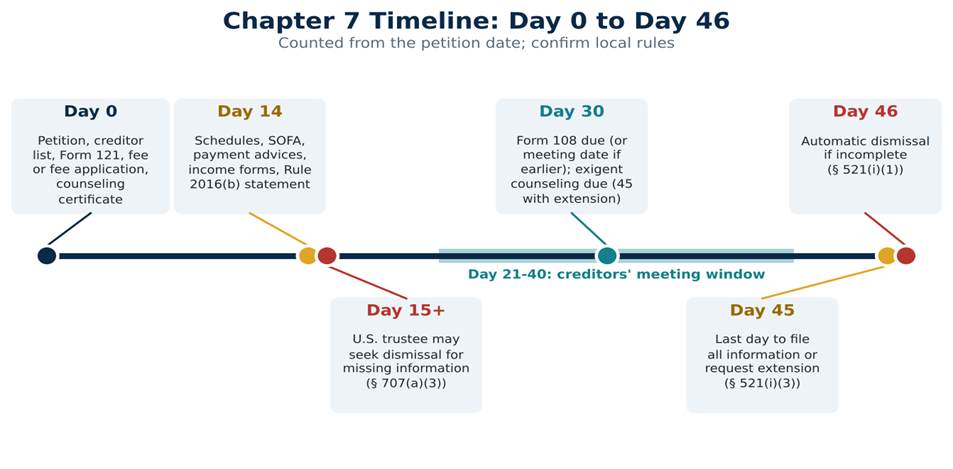
Rule 1007(c)(1) gives a voluntary debtor 14 days after the petition to file schedules and the statement of financial affairs. That window also covers payment advices from the prior 60 days, current income forms, and counsel’s Rule 2016(b) statement. The timeline below maps each deadline to a single day count from the petition date.
Where the 14-Day Deadline Leads
Missing the 14-day deadline does not automatically end a case, but it invites a dismissal motion. Section 707(a)(3) lets the United States trustee seek dismissal if required information is not filed within 15 days. Some districts add deficiency notices or local-rule consequences, so check each court’s procedures before relying on any deadline.
Extending the Deadline Safely
A motion to extend should be filed before the 14 days expire, because some local rules require that timing. Rule 1007(c)(7) permits an extension on motion and for cause, with notice to the United States trustee and others. The motion should state a concrete reason, a date certain, and the documents still outstanding.
The Hard Stop at Day 46
The 14-day deadline can be extended, but the statute sets a harder limit at day 46. Under 11 U.S.C. § 521(i)(1), a Chapter 7 case is automatically dismissed on day 46 if required information is missing. A court may add up to 45 days, but only on a request made within the first 45.
Why Chapter 7 Cases Fail After a Skeleton Filing
Post-filing failures often trace to a short list of avoidable gaps, and a disciplined checklist can control each one. The list below ties each gap to its governing rule or statute so teams can build the checklist directly from it. Treat every item as a dated task assigned to a named person on day zero.
- Payment advices missing for the 60 days before filing (11 U.S.C. § 521(a)(1)(B)(iv); Rule 1007(b)(1)(E))
- Statement of financial affairs incomplete or unsigned (Rule 1007(b)(1)(D))
- Credit counseling certificate absent or out of time (11 U.S.C. § 109(h); Rule 1007(c)(3))
- Means-test forms not filed (Rule 1007(b)(4))
- Extension requested late or not at all (Rule 1007(c)(7); 11 U.S.C. § 521(i)(3))
- Deficiency notices ignored because no one owned the calendar (Rule 1017(c); local rules)
Payment advices deserve a dedicated workflow because they come from the debtor’s employer and must cover the 60 days before filing. Rule 1007(b)(1)(E) requires redaction of all but the last four digits of any Social Security number. Courts have dismissed cases under § 521(i) over a single missing advice, so check completeness against the pay frequency.
Skeleton Petition Versus Complete Petition
A skeleton petition is an informal term for a filing with only the documents needed to open the case. Completing the case is a separate project, and it begins the moment the petition is filed.
The table compares what each stage typically includes so attorneys can scope the work before the clock starts.
| Element | Skeleton filing (day 0) | Completion |
| Petition and creditor list | Included | Already filed |
| Schedules A/B through J | Not included | Within 14 days |
| Statement of financial affairs | Not included | Within 14 days |
| Payment advices and income forms | Not included | Within 14 days |
| Attorney compensation statement | Not included | Within 14 days (Rule 2016(b)) |
| Statement of intention (Form 108) | Not included | Within 30 days or by the meeting date |
Do Not Overlook the Statement of Intention
The statement of intention (Form 108) is due within 30 days after filing or by the meeting date, whichever is earlier. Rule 1007(b)(2) also requires service of a copy on the trustee and the creditors named in the statement. Secured-creditor details gathered at intake make this form faster and more accurate to complete later.
Draft Bankruptcy Petition Accuracy: What to Verify Before Filing
Speed introduces transcription risk, and a wrong digit or omitted creditor can create avoidable amendments after filing. Attorneys should verify the debtor’s legal name against identification and confirm the Social Security number on the Form 121 statement. They should also confirm that venue under 28 U.S.C. § 1408 is proper for the district.
- Every creditor, including secured lenders and landlords, appears on the list
- Property addresses and lender details match foreclosure or repossession notices
- Prior bankruptcy filings are disclosed accurately
- Attorney signature and debtor verification are complete
Official Form 101 asks whether the debtor filed bankruptcy within the last eight years and requests the district, date, and case number. Accurate prior-case data lets the attorney assess eligibility and stay questions before filing instead of after.
How a Bankruptcy Petition Service Protects the Case
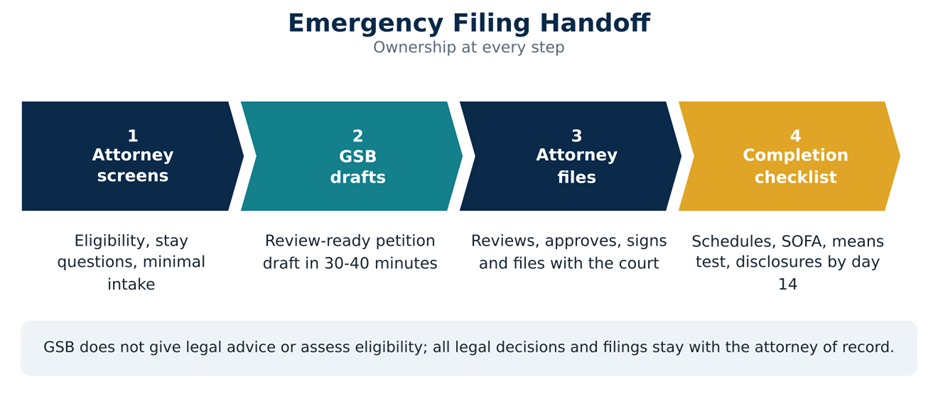
A bankruptcy petition service reduces failure risk by separating fast drafting from careful, documented completion work. The bankruptcy petition service prepares review-ready emergency petition drafts, then supports the schedules, statement of financial affairs, means test, and disclosures that follow. The attorney of record reviews and approves every document, and the attorney’s office completes all court filings.
A Practical Handoff Sequence
The sequence in the graphic keeps ownership clear at every step, which matters most when the attorney is under time pressure. The attorney screens eligibility and sends minimal intake, and returns a draft in 30 to 40 minutes. After review and filing, completion tasks run on a dated checklist through the 14-day deadline.
Compliance Points for Attorneys Using Outside Preparers
The support service for emergency filing does not provide legal advice, interpret bankruptcy law, or assess eligibility. Eligibility questions, automatic stay analysis, and case strategy therefore remain entirely with the attorney of record. Federal Rule of Bankruptcy Procedure 9011 also makes the signing attorney responsible for a reasonable inquiry into every filing.
Section 110 regulates bankruptcy petition preparers, meaning anyone other than the debtor’s attorney or that attorney’s directly supervised employee who prepares documents for compensation. A third-party service may fall outside the employee exception, so firms should confirm with ethics counsel how Section 110 applies to their arrangement.
Calendar and Communication Controls for the First 14 Days
Rule 9006(a) governs the count: exclude the filing day, count every calendar day, and carry weekend deadlines forward. Enter each date in the firm calendar on day zero, with reminders at the halfway point and 48 hours before. Verify each date against the court’s local rules, because local requirements can differ from the national rules.
Assign each document to a named owner and review the docket daily for deficiency notices. Give the client a written list of items and dates, because payment advices and tax returns come from the debtor. Escalate any missing item to the attorney by day seven, which leaves time to request an extension.
Wrapping Up: Protect the Case After the Filing
An emergency Chapter 7 filing buys time, and the 14-day window decides whether that time is used well. Build the deadline map on day zero, assign every item to an owner, and calendar the extension decision early. A dependable petition service can compress drafting time so attorneys spend their hours on legal judgment.
Need review-ready emergency petition drafts? Talk to GSB LPO Services about Chapter 7 filing support.
Frequently Asked Questions
What happens to the automatic stay if the debtor had a prior case dismissed within the past year?
Under 11 U.S.C. § 362(c)(3), the stay can end on day 30 if one earlier case was dismissed within the prior year. Extending it requires a motion showing good faith, with the hearing completed within those 30 days. With two or more dismissals in that year, § 362(c)(4) says no stay takes effect automatically.
Can the debtor pay the Chapter 7 filing fee in installments?
Yes, an individual debtor may apply to pay in installments on Official Form 103A under Rule 1006(b). The Chapter 7 filing fee is currently $338, and the final installment must be due within 120 days after the petition. A missed installment can lead to dismissal, so calendar every payment date alongside the other deadlines.
What if the debtor discovers an omitted creditor or new property after filing?
Rule 1009(a) allows a debtor to amend a voluntary petition, list, schedule, or statement as a matter of course before the case closes. Newly acquired property described in § 541(a)(5), such as an inheritance, requires a supplemental schedule within 14 days after the debtor learns of it.
What happens if the debtor does not complete the financial management course?
Rule 1007(c)(4) generally requires the course certificate within 60 days after the first date set for the creditors’ meeting. A debtor who skips the course risks losing the discharge, and the case may close without one. The court can extend the deadline for cause, and some providers report completion directly to the court