


Law firm workload rarely arrives in a steady, predictable pattern. A new matter can trigger intake, conflict checks, records collection, calendaring, pleadings, discovery, and client communication within days. Meanwhile, active litigation continues to generate deadlines, document review, deposition preparation, and filing coordination.
Offshore paralegal services provide additional execution capacity when firms define tasks carefully and retain attorney supervision. The strongest model delegates repeatable, document-intensive work, establishes clear review gates, and protects client information throughout the engagement.
This article defines what paralegals can do for attorneys, which tasks are billable, and how to divide work across an offshore team. It closes with the ethics controls and a rollout plan suited to small law firms.
What Tasks Can a Paralegal Do for an Attorney?
The Bureau of Labor Statistics lists fact investigation, legal research, document organization, drafting, and court filing among core paralegal duties. Specific duties vary by practice area, such as bankruptcy or intellectual property, and by firm size. In small firms, paralegals may work on all aspects of a case from beginning to end.
Tasks Commonly Delegated Before and During Litigation
The commonly delegated tasks are as follows:
| Phase | Common paralegal tasks (all subject to attorney review) |
| Pre-litigation | Intake support, records requests, medical chronologies, demand letter drafts, and document review |
| Litigation | Draft pleadings and discovery responses, subpoenaed records management, deposition summaries, exhibit preparation, and filing preparation |
| Both phases | Calendar management, client status communication under attorney direction, and file organization |
Delegation works best when each task has a clear deliverable and a named reviewer inside the firm. A chronology, a draft pleading, or a records index can be checked against source documents, while open-ended assignments invite misunderstanding. Define the deliverable first, and the right level of paralegal support becomes much easier to choose.
What Only the Attorney Can Do
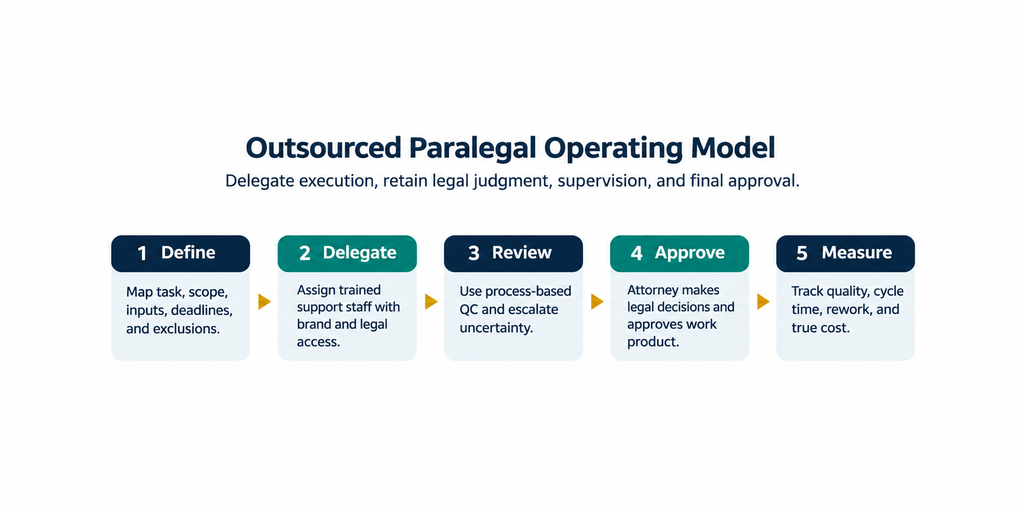
The ABA Model Guidelines for the Utilization of Paralegal Services let lawyers delegate any task law does not reserve to attorneys. Lawyers cannot delegate establishing the client relationship, setting the fee, or giving the client a legal opinion. Paralegals may not give legal advice or appear in court as counsel, since both are unauthorized practice.
Billable Paralegal Tasks: What Counts and What Does Not
Paralegal time is generally billable when it applies legal skill and training under attorney supervision. In Missouri v. Jenkins, 491 U.S. 274 (1989), the Supreme Court held that statutory fee awards may include paralegal time at market rates. The decision also notes that purely clerical tasks should not be billed at a paralegal rate.
| Generally billable (legal skill) | Generally clerical overhead |
| Drafting demand letters, pleadings, and discovery responses | Converting documents to PDF |
| Summarizing medical records and depositions | Mailing and faxing |
| Reviewing documents for relevance and privilege | Updating calendars and contact lists |
| Preparing exhibits and trial materials | Routine filing and copying |
Billing rules also vary by jurisdiction and fee arrangement, so engagement letters should state how paralegal time will be treated. ABA Formal Opinions 93-379, 00-420, and 08-451 address billing for disbursements, surcharges, and outsourced services. Confirm your state’s position and your engagement terms before adding any markup to outsourced paralegal work.
Documenting Paralegal Time
Time entries should describe the legal task and its purpose rather than a generic activity. A description such as drafting a medical chronology from provider records communicates substance, while “worked on file” does not. Specific entries help clients understand the invoice and help courts evaluate any fee petition that follows.
Pre-Litigation and Litigation: Where Offshore Support Works Best
Pre-litigation workflows are especially suitable for structured support because much of the work involves collecting, organizing, and comparing information. Litigation creates a continuing stream of tasks with different levels of legal sensitivity. A support provider can absorb structured preparation while the attorney directs strategy.
What Is Pre-Litigation Support?
Pre-litigation work is document-heavy and deadline-sensitive, which makes it a strong fit for offshore support. Intake packets, records organization, medical chronologies, and demand drafts all follow repeatable steps that trained teams can standardize.
Offshore services usually support personal injury, bankruptcy, workers’ compensation, SBA debt resolution, contract management, and legal document review matters.
| Phase | Typical offshore tasks | Associated services |
| Pre-litigation | Medical records organization, chronologies, demand packages | Personal injury |
| Pre-litigation | Petition and amendment drafting | Bankruptcy filings |
| Litigation | Pleadings, subpoenaed records, medical-legal coordination | Workers’ compensation |
| Litigation | Settlement documentation, e-filing and mailing support | Workers’ compensation |
What Is Litigation Support
Once suit is filed, volume shifts to pleadings, subpoenaed records, hearing notices, and settlement documents.
The team to whom you have outsourced work handles pleadings and legal filings, subpoena duces tecum records management, medical-legal coordination, settlement documentation, and e-filing support. Attorneys remain responsible for reviewing each item before it is signed, served, or filed with a tribunal.
How Is the Overnight Advantage Realized During Outsourcing
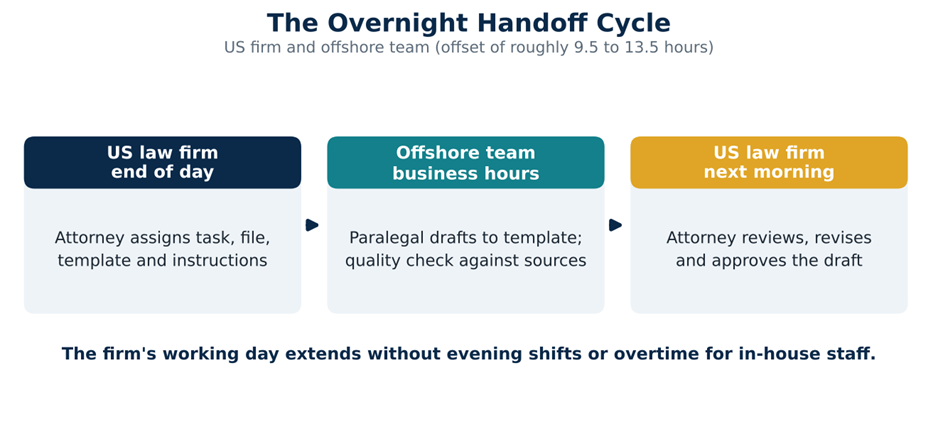
India Standard Time runs 9.5 to 13.5 hours ahead of continental US zones, depending on zone and daylight saving time. Attorneys can assign work at the end of their day and review a finished draft the next morning. The cycle extends the firm’s productive day without adding evening shifts or overtime for in-house staff.
How an Assignment Moves From Intake to Delivery
A repeatable handoff reduces rework because both sides know exactly what each assignment must contain. For a streamlined process, the client (or firm planning to outsource work) shares the task, file, templates, and instructions, and the team confirms scope. A paralegal completes the work, and the draft returns for attorney review, usually within 24 hours for standard tasks.
Stepwise, the process is as follows:
- Attorney defines the task and shares the file
- Provider confirms scope and assigns a paralegal
- Paralegal drafts to the firm’s template
- Quality check against source documents
- Attorney reviews, revises, and approves
What Are the Instructions That Prevent Rework
Written instructions should state the template, the governing jurisdiction, the deadline, and the output format. Add a short list of known issues, such as prior claims or missing records, so the paralegal flags them rather than guessing. Clear instructions also speed attorney review because the reviewer knows exactly which items to verify first.
Paralegal Support for Small Law Firms: The Capacity Math
Small firms feel workload swings first because each hire is a large share of payroll. The Bureau of Labor Statistics reported a median annual wage of $62,890 for paralegals in May 2025, before benefits, training, and workspace. Project-based or hourly offshore support converts part of that fixed cost into a variable cost.
For paralegal support services, the billing structures can be hourly, case-based, and monthly engagement. A hire-when-you-need model lets firms use offshore paralegals occasionally and exit if they prefer to stay in-house. A free pilot project lets a firm test quality on live work before committing to ongoing support.
Choosing the Right Tasks to Delegate First
Small firms should start with work that is repetitive, template-driven, and light on direct client contact. Those tasks produce measurable results quickly and carry the lowest risk if a first draft needs revision.
The list below shows common service lines:
- Medical record organization and chronologies
- Demand letter first drafts
- Bankruptcy petition and schedule drafts
- Document review and indexing
- Subpoenaed records management
Ethics and Risk Controls for Offshore Paralegal Services
Offshore support is permissible when the supervising lawyer remains responsible, and the supervision is genuine. ABA Formal Opinion 08-451 ties outsourcing to Rules 1.1, 5.1, and 5.3, whether or not the provider sits inside the firm. Rule 5.3 Comment [3] adds that lawyers must make reasonable efforts to keep outside services compatible with their obligations.
Confidentiality and data handling need written controls, including a signed agreement, role-based access, and encrypted file transfer. The agreement should also address data return and deletion at the end of an engagement. SOC 2, ISO 27001, and HIPAA compliance are a must for firms offering assistance, and anyone planning to seek offshore support should request relevant supporting documentation.
Client communication matters as well, and ABA Formal Opinion 08-451 advises disclosure and informed consent when confidential information will be shared. State bar opinions differ, so review your own jurisdiction’s guidance before onboarding any outside provider. State the arrangement and the fee treatment in your engagement letter so the client is never surprised.
Offshore Due Diligence Checklist
Due diligence should end in documents rather than impressions, so collect the items below before the first assignment. File them with your engagement records so that supervision can be demonstrated if a regulator or client asks. Revisit the file whenever the scope, the assigned team, or the technology changes materially.
A thorough checklist that must be maintained is as follows:
- Written scope of work with defined tasks and deliverables
- Signed confidentiality and data-handling agreement
- Named point of contact and escalation path
- Documented quality-control and review steps
- Defined turnaround targets by task type
- Compatibility with your case management software
A 30-Day Rollout Plan for Small Firms
A structured rollout limits risk and produces the evidence you need to decide whether to expand the relationship. Use the first month to prove quality on one task type, measure the results, and expand only after they hold. The graphic below outlines a four-week sequence that firms of nearly any size can adapt.
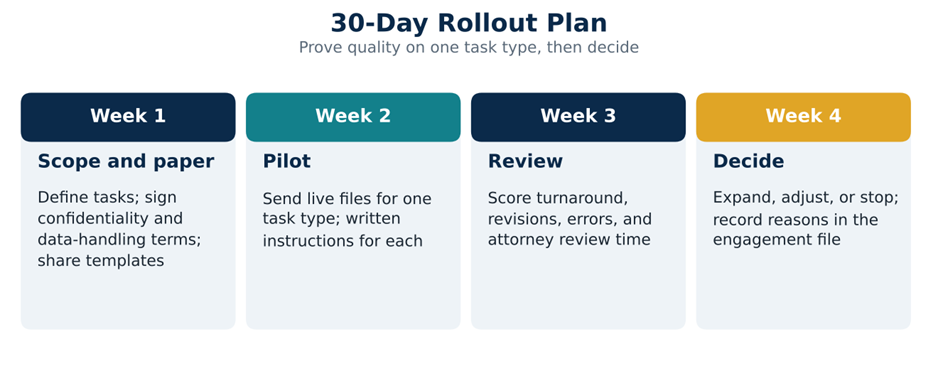
At day 30, compare the pilot data with your goals and decide whether to expand, adjust, or stop. Record the decision and the reasons in the engagement file so that supervision is documented. Whatever the outcome, the pilot gives you firsthand evidence that a sales presentation cannot supply.
Wrapping Up: Make Offshore Support Work for Your Practice
Offshore paralegal services work best when attorneys delegate defined, repeatable tasks and keep every legal judgment. The billing rules, supervision duties, and confidentiality controls above are manageable with a written scope and a documented pilot. Firms that start small can scale capacity as the caseload demands without committing to permanent headcount.
Want to see the workflow on your own files? Start with a free pilot project from GSB LPO Services.
Frequently Asked Questions
Which metrics should a firm track to evaluate an offshore paralegal team?
Track turnaround time against the agreed target, the revision rate per assignment, and the factual or citation errors caught in review. Add the cost per completed deliverable so you can compare outsourced and in-house work on equal terms. Review the figures monthly and adjust the scope whenever they drift away from your targets.
Can an offshore paralegal use the attorney’s e-filing or PACER credentials?
Firms should generally avoid sharing court e-filing credentials with offshore providers; local rules should guide the decision. A CM/ECF login typically operates as the registered attorney’s signature, and local rules often make that user responsible for filings. A safer model has the offshore team prepare filing-ready documents while the attorney or authorized staff submit them.
How much attorney time should we budget to supervise outsourced work?
No fixed ratio applies, because review time depends on task type, template quality, and the provider’s track record. Plan for heavier review during the pilot, then compare actual review minutes with the drafting time you would have spent. Reduce review intensity only when error data supports the change, never simply to save time.
Which practice areas or tasks are a poor fit for offshore paralegal support?
Tasks that require in-person presence, direct client counseling, or court appearances should stay with attorneys or local staff. Matters with strict data-location or security requirements, such as some government or export-controlled work, may rule out offshore handling. Always check client contracts, outside counsel guidelines, and protective orders before sending any file abroad.